
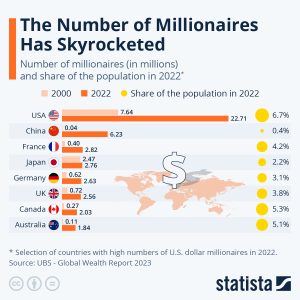
Source: UBS Global Wealth Report 2023
The global distribution of wealth has garnered considerable attention, especially with the rise of emerging markets and technological progress. As of recent estimates from Kiplinger, there are approximately 59 million millionaires worldwide. However, this figure might slightly decrease if accounting for “inflation millionaires” who might not qualify once inflation adjustments are considered.
Looking ahead, studies project that the number of millionaires globally could reach 86 million by 2027, indicating a significant upward trend. Currently, the United States leads globally with more than 18 million millionaires, driven by favorable economic conditions and advancements in sectors like technology, oil, and global trade. China follows with over 6.19 million millionaires, propelled by its status as a technology hub and strategic investments in industries such as automotive and electronics.
Germany, Europe’s largest economy, hosts over 400,000 millionaires, thanks to a robust economy bolstered by strong engineering and industrial sectors including automotive, mechanical engineering, chemical, and electrical industries.
Looking forward, countries like India and Indonesia are expected to see rising numbers of millionaires as their economies grow and technological advancements continue to reshape global wealth distribution. As we progress through the 21st century, these dynamics are likely to evolve further.